




A vehicle that will not start cannot roll, steer, or brake on its own, which makes loading it onto a trailer harder than it looks. The right gear matters: a correctly rated winch, J-hooks, and ratchet straps. Used properly, they prevent vehicle damage, protect you from snapping lines, and keep the load secured on the highway.
Key Takeway
- Choose a winch rated at 1.5 to 2 times the vehicle’s weight to handle extra resistance from locked brakes, mud, or steep ramps.
- Prepare the trailer on level ground, check the hitch and weight ratings, and make sure the vehicle can roll and steer before loading.
- Use the correct J hooks and a V bridle to winch the vehicle slowly in a straight line while keeping bystanders clear of the cable.
- Position the vehicle with about 60% of its weight ahead of the trailer axles to help maintain proper tongue weight and stability.
- Secure all four corners independently with properly rated straps, keep them clear of brake lines and wiring, and add safety chains as backup.
- Drive smoothly, recheck the straps and connections after the first 50 miles, and confirm local towing laws and insurance requirements before travelling.
1. Equipment You Need (Checklist)
Core gear: a winch rated 1.5x to 2x the vehicle’s weight, hooks matched to the vehicle, four axle straps (3,333 lb WLL each), ratchet straps or chains, and safety gear.
The Winch
Choose a winch rated at 1.5x to 2x the vehicle’s gross weight, since locked brakes, mud, or a steep ramp add drag. A 6,000 lb car needs at least a 9,000 lb winch. Check the duty cycle on electric units because a long, steep pull can overheat a budget winch. Synthetic rope is safer than steel cable if the line breaks. A hydraulic winch handles continuous heavy recovery better than most electric models.
J-Hooks, T-Hooks, and R-Hooks
Match the hook profile to the frame slot. R-hooks fit GM and Chrysler slots. T-hooks fit Ford middle slots. J-hooks fit many import axle loops and some frame slots. Forcing the wrong hook into a slot can deform the frame hole under load. Always tug the hook to confirm it is seated against the reinforcement before winching.
Ratchet Straps
Axle straps loop around a solid axle or suspension member, while wheel nets and over-the-wheel lassos hold the tire and let the suspension move freely. Pick straps whose combined working load limit (WLL) is at least half the vehicle’s weight. WLL, not breaking strength, is the number that counts, so skip any frayed or cut webbing.
Ratchet Straps and Axle Straps
Use four 2-inch axle straps rated at least 3,333 lb WLL each, looped around solid axles or lower control arms. Pick straps whose combined working load limit (WLL) is at least half the vehicle’s weight. WLL, not breaking strength, is the number that counts, so skip any frayed or cut webbing.
Tie-Down Straps and Chains
Every hook, strap, ratchet, and D-ring must have a legible working load limit. Chains store little energy if they break but can mar expensive wheels and suspension parts. Synthetic straps are gentler but degrade from UV and abrasion. Never link two straps with a clevis pin because the pin can become a projectile if a strap fails. Replace any strap with cuts, burns, or faded tags.
Safety Gear
Wear heavy leather gloves, especially with steel cable, since broken strands cut hands. Drape a winch line damper, such as a heavy blanket or jacket, over the line to absorb energy if it snaps. Add safety glasses, wheel chocks, and DOT-approved safety chains for the trailer coupler. Keep it all in one bin so nothing gets skipped.
2. Preparing the Trailer and the Dead Vehicle
A safe load starts before the car moves. Checking the hitch, weights, and ramps, then getting the dead car into neutral with free-turning wheels, prevents most winching problems, trailer sway, and ramp damage.
Check Weights, Hitch, Lights, and Brakes
Confirm the car’s curb weight plus the trailer’s weight stays under the tow vehicle’s rated capacity and the trailer’s GVWR. Match the hitch ball to the coupler and check its tongue-weight rating. Test running lights, brake lights, turn signals, and trailer brakes. A dead load exposes every weakness, and a brake controller failure on a downhill grade can be unrecoverable. So, do these checks before the car goes on, not after.
Trailer Positioning
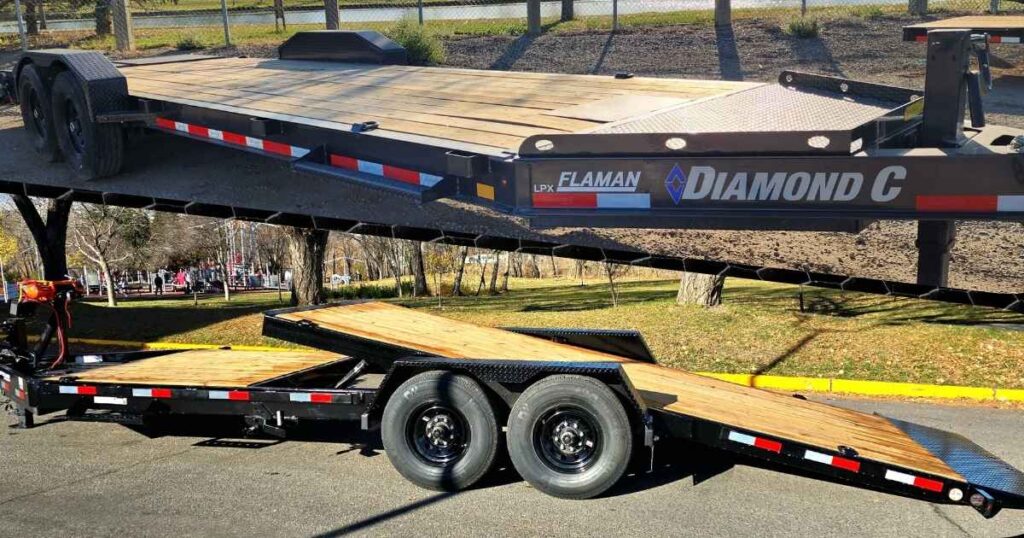
Park the trailer and tow vehicle in a straight line on level, firm ground. Set the tow vehicle’s parking brake and chock the trailer wheels. Lower the ramps and lock any extenders to keep the angle gentle, or fully tilt the bed. If the ramps can slide under load, the entire pull becomes unstable, so reposition until they are solid.
Vehicle Prep
Shift the car into neutral before loading. With a dead battery, electronic shifters usually have a manual shift lock override, often a small slot or cover near the lever, and some cars need 12V power to release the electronic parking brake. The steering wheel must also be unlocked so an assistant can steer the car as it climbs the ramps. If you cannot get the vehicle into Neutral, use wheel skates or a different loading method.
Weight Distribution Strategy
Plan the pull so the engine, usually the heaviest part, ends up ahead of the trailer axles. Aim for about 60% of the vehicle’s weight forward of the axles, which keeps tongue weight near 10 to 15% of the total load. Too little tongue weight causes dangerous trailer sway at speed, so load front-engine cars nose first.
3. How to Winch a Non-Running Vehicle Onto a Trailer (The Pull)
The pull starts with the right hook seated in the right frame slot. Connect the V-bridle, keep the pull straight, clear bystanders, and winch slowly while a helper steers, stopping at the 60/40 position.
Attaching the J-Hooks
Find the factory transport slots in the subframe, usually behind the front wheels and ahead of the rear wheels. Insert the correct hook and rotate it so it seats against the reinforcement. Tug the hook to confirm it is seated, not merely hanging in the hole. If no frame slot is usable, use a soft axle strap around a lower control arm. Never attach to a bumper, sway bar, or rusted crossmember.
Connecting the Bridle to the Winch
Join the V-bridle’s two legs to the J-hooks and run the single end to the winch hook. Line up the car and trailer so the pull is dead straight, with a spotter guiding. Take up slack slowly and stop when the line is snug. Check that the bridle sits centered, since an angled pull drags the car sideways and can slip a hook.
The Pull
Clear the danger zone. Bystanders stand at least 1.5 times the cable length away and behind a solid object. Winch slowly to remove slack, then pull smoothly. An assistant steers through the open window to keep the tires centered.
Safety Stop
Stop the winch at the 60/40 position. Set the parking brake if it works and place the transmission in Park or in gear. Chock the tires on the deck before releasing winch tension. The winch is not a tie-down.

Need to Haul a Non-Running Vehicle?
Load your vehicle safely with the right trailer, winch, and tie-down equipment. Westside Rental offers heavy-duty car haulers to help you transport non-running cars and trucks around Calgary and beyond.
4. Securing the Load: The 4-Point Tie-Down
The 4-Point Tie-Down Method
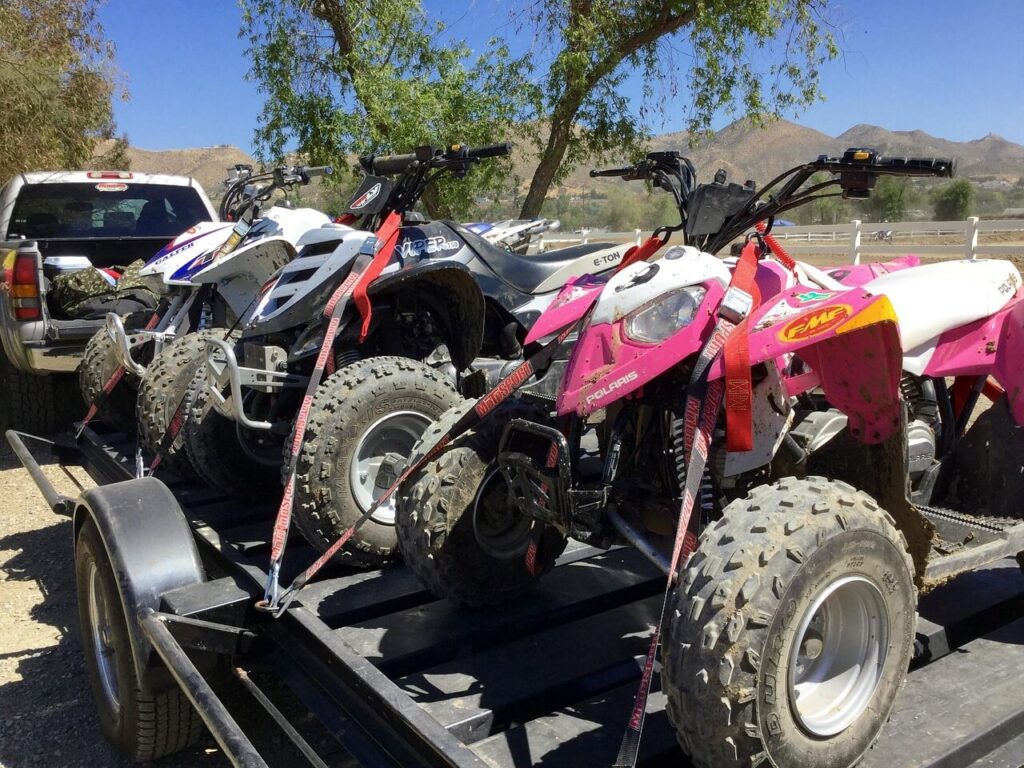
Secure all four corners independently, so no single strap or chain carries the whole load. Use two points at the front and two at the rear, each running to its own trailer anchor and angled outward from the car. If one strap fails, the other three still hold the vehicle. Never share one anchor between two straps.
Routing the Straps
Loop axle straps around a solid rear axle housing or through a sturdy lower control arm on independent suspension. Keep every strap away from brake lines, ABS wiring, CV boots, fuel lines, and sharp edges. A strap tensioned against a brake line can crimp or cut it, and you may not notice until you press the brake pedal. Use strap protectors where contact is unavoidable, and reroute any strap that touches a brake line.
Tensioning
Tension each ratchet until the strap is tight and the suspension compresses slightly. Straight-line tensioning keeps each strap over its anchor point. Crossing straps can add lateral stability but increase rubbing risk.
Backup Security
Add DOT-approved safety chains as a fail-safe against strap failure. Run each chain from a solid frame or axle point to a trailer anchor with slight slack, so it only takes load if a strap lets go. Check the chain’s WLL tag, keep hooks latched, and never treat the chains as your main tie-down.
5. Towing Safely With a Non-Running Vehicle
A loaded dead vehicle changes how the rig handles. Drive smoothly, brake early, and keep speed moderate. Re-check straps, chains, hitch, and lights after 5 to 15 miles, then every 50. Confirm local laws and insurance.
Driving Tips and Speed
Drive smoothly and keep speed moderate, ideally under 90 km/h (55 mph) unless the trailer’s rating or posted limits say less. Leave extra following distance, brake early, and take wide turns. If the trailer sways, ease off the gas instead of braking hard. Avoid sudden lane changes and pick fuel stops with room to maneuver.
The 50-Mile Strap Check
Pull over after the first 50 miles (about 80 km) on a safe, level shoulder and inspect everything. Straps settle and loosen as the suspension relaxes. Re-tighten the ratchets, check chain slack, hooks, coupler, and lights, and look for strap rubbing on brake lines. After that, recheck at every fuel stop.
Legal and Insurance Considerations
Rules and insurance vary by province, so confirm your tow vehicle’s rating and that your policy covers the rented trailer and the vehicle riding on it. Read the rental agreement, ask what it covers for damage, and photograph the trailer, ramps, and tie-downs before you leave the lot. In Alberta, National Safety Code Standard 10 is the cargo securement benchmark. Carry proof of ownership and a valid license.
Final Thought
The most resourceful thing you can do before hauling a non-running vehicle is to match the equipment to the load, not the other way around. A 1.5x-to-2x winch, the correct hook for the frame, four rated axle straps, and a straight, dampened pull will get the vehicle on the deck. But the haul is not over until the vehicle is secured at four independent points, with straps routed clear of brake lines and a safety chain as a fail-safe.
If any part of the rig (the winch, the hooks, the straps, or the trailer) is undersized or in doubtful condition, stop. A professional flatbed tow costs far less than a dropped load, a damaged frame, or a brake line that fails on the road.
faq
Frequently Asked Questions
How do you load a car that won't start onto a trailer?
Put the car in neutral, release the parking brake, attach J-hooks and a V-bridle, and winch it slowly up the ramps while someone steers. Position the engine ahead of the trailer axles, then secure all four corners with straps or chains.
Can you winch a car onto a trailer without power?
Yes. The car supplies no power during a winch pull. You only need a charged 12V source for the winch, plus the car in neutral with the brake released. For light cars, a manual winch or come-along also works, just more slowly.
How do you put a car in neutral with a dead battery?
Use the shift lock override, usually a small cover or slot beside the shifter, pressing it with a key or screwdriver while moving the lever to N. Some cars also need 12V power to release the electronic parking brake, so check the owner's manual.
What size winch do I need to load a car?
Choose a winch rated at 1.5x to 2x the vehicle's weight. A 4,000 lb car needs at least a 6,000 lb winch, and more if you have steep ramps, locked brakes, or a heavy truck or SUV.
Where do you attach J-hooks on a car?
Attach them to the factory transport slots or holes on the frame or subframe. Avoid bumpers, plastic covers, suspension arms, and exhaust parts. If the owner's manual shows no points, ask a tow professional before pulling.
Are J-hooks or wheel straps better for tie-down?
A receiver hitch has to be installed on your vehicle and rated for the loaded trailer before pickup. Plan for installation time ahead of your booking date. Ball mounts can be added to a rental, but the receiver itself must already be on your vehicle.
Does payload matter as much as towing capacity?
Often more. Tongue weight, usually 10 to 15 percent of the loaded trailer, plus passengers and gear all count against payload. A truck can sit well under its tow rating and still exceed payload, especially mid-size trucks and half-tons carrying a full crew and gear.