

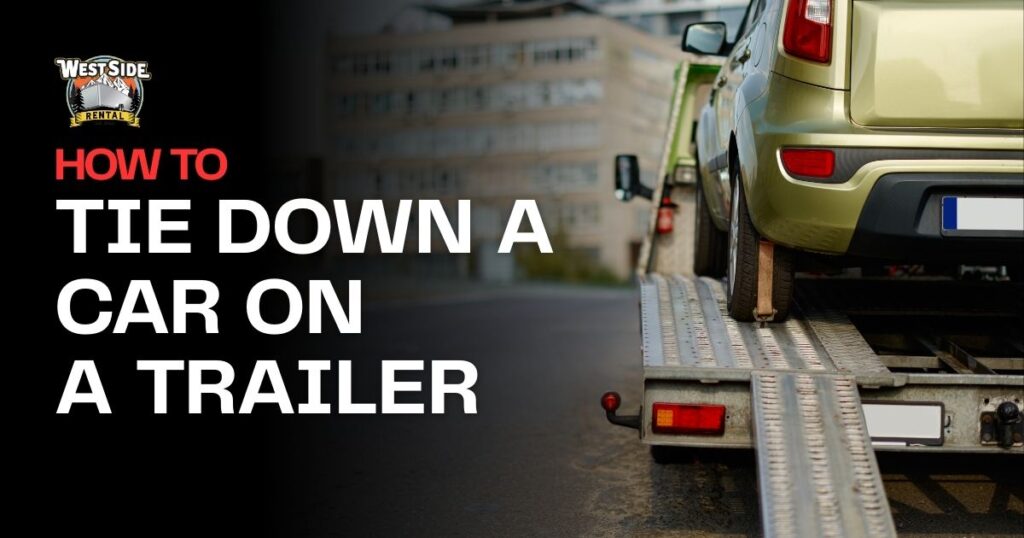
How to Safely Tie Down a Car on a Flatbed Trailer
- September 29, 2025
- Towing Tips
- seo-manager
If you’ve ever stood next to your car and trailer before a trip, you’ve probably had the same questions running through your head. Should I strap to the chassis, the suspension, or the tires? Are ratchet straps enough, or do I need chains too? Do I cross the straps into an “X,” or keep them straight? Should the car stay in gear or neutral? And what about a safety chain—do I even need one?
We know these aren’t small worries, and the way you are thinking is not wrong. A single mistake can risk the whole load, damage your vehicle, or endanger others on the road.
Let’s guide you step by step!
What You’ll Need to Car Tie Downs
Before you begin, make sure you have all the essentials so that everything goes smoothly.
- Ratchet Straps or winch straps: Heavy-duty straps with a working load limit (WLL) suitable for the vehicle’s weight.
- Axle Straps: Designed to loop around the vehicle’s axles, providing secure attachment points.
- Wheel Straps / Tire Nets: An Alternative to axle straps, wrapping around the tires to secure the vehicle.
- D-Rings or Anchor Points: Fixed points on the trailer to attach tie-downs securely.
- Protective Sleeves or Padding: To prevent straps from abrasion and to protect the vehicle’s finish.
- Wheel Chocks: Placed in front of and behind the tires to prevent vehicle movement.
- Gloves: To protect hands while handling straps and securing the vehicle.
- Winch: Useful for pulling the vehicle onto the trailer if necessary.
Step-by-Step Instructions
1. Load the Vehicle Safely
Start by parking the trailer on flat, level ground and setting the tow vehicle’s parking brake. Make sure your car is center and keep the trailer front to back on the trailer. Double-check that the car’s weight is evenly distributed.
2. Select Your Tie-Down Points
Identify strong, secure tie-down points on both the car and the trailer. Good points are the car’s frame, axles, or designated tie-down hooks. Avoid fragile components like steering parts, exhaust, or areas that can be damaged. If you can, use axle straps or tire-basket straps that wrap around tires.
3. Choose the Right Strapping Method
Use tire straps if you’re hauling a modern or small vehicle. Tire straps wrap over the tires, using the trailer’s weight to stabilize the car without stressing suspension parts.
Use axle straps for heavier, older, or classic cars. Axle straps let the suspension move freely and are stronger for bulky vehicles.
4. Secure Each Wheel or Axle
With tire straps: Loop a lasso strap around the tire and pull it tight. Thread it through the ratchet buckle and hook it to the trailer’s D-ring. Tighten until the strap squeezes the tire but doesn’t touch body parts. Repeat for all four tires.
With axle straps: Wrap the strap around the axle (padded side against the axle if available). Clip a ratchet strap to the trailer’s D-ring and connect it to the axle strap’s ring. Thread the strap into the ratchet and tighten until snug but not straining the axle. Repeat for the opposite side of the rear axle, then the front axle or control arms. Avoid sway bars, steering arms, or brake lines.
5. Tighten, Tie Off, and Cross
Tighten each strap gradually. A good rule of thumb: if you need two hands to crank the ratchet further, it’s tight enough. Tie off excess strap length to keep it from flapping. Cross rear straps if possible (left trailer anchor to right axle, and vice versa) to form an “X.” This reduces side-to-side movement.
6. Attach Safety Chains
If your trailer has a safety chain, wrap it around a solid part of your car’s chassis or control arm and clip it into place. You don’t need to make it tight — it’s there as a backup if straps fail
7. Stow Ramps and Check Everything
Before moving, push built-in ramps back into their slots or stow external ramps securely. Walk around the trailer to confirm that:
- All straps are tight and not rubbing sharp edges.
- No brake lines, oil lines, or body panels are pinched.
- All hooks and ratchets are locked.
8.Test Drive and Re-Check
Drive your trailer slowly in a safe area (parking lot or quiet street) to test braking, turning, and handling. After 10–25 miles, stop and recheck every strap. Ratchet straps can stretch during the first miles. Recheck at every fuel or food stop on long trips.
Key Tips for Safety
- Always use straps rated for vehicle tie-downs (not general cargo straps).
- Don’t overtighten the straps, it can damage suspension or axles.
- Use minimum 4 straps (two front, two rear).
- Check your towing vehicle’s tires and brakes before leaving.
Conclusion
By following these steps (loading carefully, choosing the right straps, securing each corner, tying off, and rechecking on the road) you’ll transport your car more safely with confidence.
A few extra minutes spent on proper strapping can prevent expensive damage and keep you and others safe on the road.
Recent posts


Reach Us
Share
LinkedIn
X
Pinterest
Facebook