




Over years of trailer rentals in Calgary, the same question comes up before almost every booking: will my truck handle this? Most people send us their vehicle and the load, then wait for a yes or a no. What we’ve noticed is that the vehicle is rarely the whole story. The loaded weight of the trailer, the payload left in your truck and a few pieces of hitch hardware decide most outcomes. This guide walks through half-ton and 3/4-ton trucks, one-tons, SUVs, Jeeps and mid-size trucks like the GMC Canyon, using the weights we see on real rental days.
Key Takeway
- Check your vehicle’s towing capacity, payload, and the trailer’s loaded weight before booking.
- Match the trailer to your cargo weight and choose a suitable size for the job.
- Make sure your hitch, 2 5/16 inch ball, wiring, and brake controller meet the trailer’s requirements.
- Remember that passengers, gear, and trailer tongue weight all count toward your vehicle’s payload.
- Stay within your vehicle’s towing limits and the trailer’s GVWR and payload ratings.
The Three Numbers That Decide Whether Your Vehicle Can Tow
Towing capacity
Trailer towing capacity is the maximum trailer weight your vehicle is rated to pull safely. The manufacturer sets this rating based on the engine, axle ratio, cab, and tow packages. Two trucks with the same badge can have very different ratings. You will find your vehicle’s rating on the label or owner’s manual for your exact configuration, and that can make sure you know how much you can tow.
Payload and tongue weight
Payload is how much weight your vehicle can carry. This includes passengers, aftermarket accessories, and the trailer tongue weight. Tongue weight is the downward force the trailer puts on the hitch. It is usually 10 to 15 percent of the loaded trailer weight, and it counts against your payload.
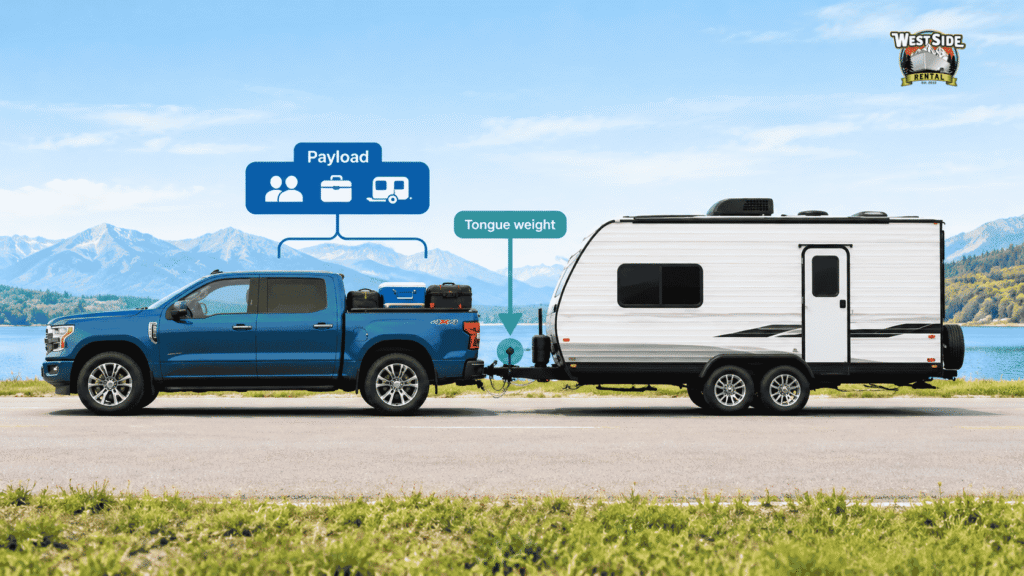
Example:
You tow a 7,000 lb loaded trailer with a truck that has an 11,500 lb towing capacity and a 1,600 lb payload.
Tongue weight = 7,000 x 10% to 15% = 700 to 1,050 lb
Now add everything else the truck is carrying:
- Tongue weight (15% worst case) is 1,050 lb.
- Driver and one passenger weigh 350 lb.
- Toolbox and aftermarket accessories weigh 150 lb.
- Weight distribution hitch weighs 100 lb.
Total payload used = 1,050 + 350 + 150 + 100 = 1,650 lb
Payload limit: 1,600 lb. Total used: 1,650 lb. You are 50 lb over, which is why a truck with a high tow rating can still run out of payload first.
Loaded trailer weight
Loaded trailer weight, also called Gross Trailer Weight (GTW), is how much your trailer weighs when it’s ready to tow. It includes the trailer itself, plus everything on it: cargo, fuel, water, and gear. This weight must not exceed the trailer’s Gross Vehicle Weight Rating (GVWR), which is the maximum total weight allowed for the trailer, including the trailer itself and everything loaded onto it.
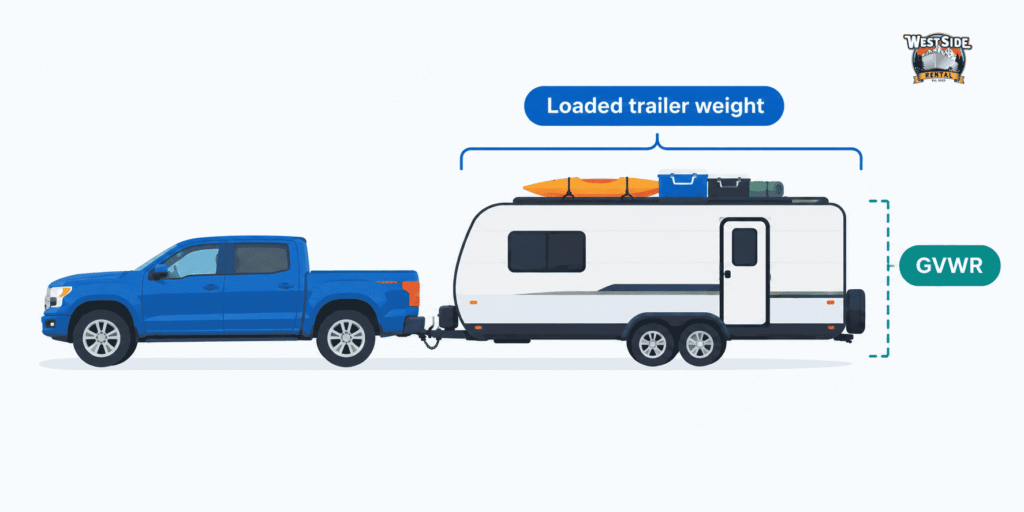
Example:
You tow a 7,000 lb loaded trailer with a truck that has an 11,500 lb towing capacity and a 1,600 lb payload.
Tongue weight = 7,000 x 10% to 15% = 700 to 1,050 lb
Now add everything else the truck is carrying:
- Tongue weight (15% worst case) is 1,050 lb.
- Driver and one passenger weigh 350 lb.
- Toolbox and aftermarket accessories weigh 150 lb.
- Weight distribution hitch weighs 100 lb.
Total payload used = 1,050 + 350 + 150 + 100 = 1,650 lb
Payload limit: 1,600 lb. Total used: 1,650 lb. You are 50 lb over, which is why a truck with a high tow rating can still run out of payload first.
Start with What You’re Hauling
Find what you’re hauling to see the trailer that fits and its approximate loaded weight. Compare that number to your vehicle’s towing capacity, and add the weight of any extra gear.
| What you’re hauling | Suitable Trailer | Approx. loaded weight | GVWR |
|---|---|---|---|
|
Sports car or sedan, 3,300 to 3,700 lb |
18 ft car hauler (about 2,690 lb empty weight) or 20 ft enclosed ( 3,521 lb empty) |
6,000 to 6,400 lb |
9,890 lb |
|
SUV, 5,000 lb |
18 ft car hauler (about 2,690 lb) or 20 ft enclosed (3,521 lb) |
about 7,700 lb |
9,890 lb |
|
Non-running pickup, about 8,000 lb |
20 ft deckover (about 2,999 lb empty) |
about 11,000 lb |
15,400 lb |
|
Mini excavator, 9,000 lb |
22 ft tilt deck (about 4,400 lb empty) |
4,400 to 4,500 lb |
7,000 lb |
|
Two cubic yards of gravel |
10 ft dump (about 2,225 lb empty) |
6,200 to 8,200 lb |
11,000 lb |
Gravel and soil commonly weigh roughly 2,000 to 3,000 lb per cubic yard, which is why a small dump trailer fills up in weight long before it fills up in space. Empty weights vary slightly by unit, so ask us for the exact figure for yours.
Towing guide by vehicle
Half-ton trucks (F-150, Ram 1500, Silverado and Sierra 1500)
Half-tons are the most common tow vehicle we see, and a properly equipped one handles more than people expect: a typical car on an 18 ft car hauler, a mid-size enclosed trailer or a small dump trailer with a sensible load. Ratings vary a lot.
We have had renters quote 7,500 lb on an older F-150 and 11,000 lb on a Silverado 1500 with a max trailering package. Our smallest dump trailer has a GVWR of 11,000 lb, so a half-ton rated at 7,500 lb has to keep the load light and weigh it.
What to check:
- Tow rating for your exact engine, axle ratio and cab, not the model
- Payload on the door sticker, since tongue weight comes out of it
- Factory tow package, 7-way plug and a working brake controller
- Loaded trailer weight kept comfortably below the rated limit
3/4-ton trucks (F-250, Ram 2500, Silverado and Sierra 2500HD)
A 3/4-ton is usually the comfortable choice for 20 ft enclosed trailers and for heavier deck loads. Take the 8.5 x 20 ft enclosed: its GVWR is 10,400 lb, so a 3/4-ton rated above that cannot exceed its limit even with the trailer fully loaded. Payload and the hitch still need to match.
What to check:
- A tow rating above the trailer GVWR covers it even when fully loaded
- Payload still has to cover tongue weight, passengers and your gear
- Receiver and ball mount rated for the loaded trailer weight and hitch load
1-ton and dually trucks, including rented 1-tons
- Receiver size and 2 5/16 inch ball matched on a borrowed or rented truck
- Brake controller installed, working and set before you leave the lot
- Mirrors extended so you can see the full length of the trailer
SUVs and Jeeps (Explorer, Sequoia, Defender, Cherokee Trailhawk)
SUVs are the most mixed group. Some carry strong tow ratings, others have a hitch on the bumper and little else. Jeep ratings vary widely by model and tow package, so the name on the tailgate tells you little. For smaller vehicles, our lightest enclosed trailers, the 10, 12 and 14 ft models, are marked SUV friendly. Plug type matters too. Electric trailer brakes need a 7-way connection, and many SUVs only have a 4-pin that runs lights.
What to check:
- Tow package confirmed in the manual, not just a hitch on the bumper
- Plug type, since a 4-pin runs lights only and cannot control brakes
- Wheelbase and payload, which are both smaller on compact SUVs
- Loaded weight kept well under the rating for hills and crosswinds
Mid-size trucks (GMC Canyon, Ford Maverick)
Mid-size trucks can handle the small end of the fleet if the numbers line up. One renter with a Maverick quoted a 4,000 lb rating and asked about our smallest enclosed trailer. The 10 ft enclosed has a GVWR of 3,500 lb, so it sits under that rating at its limit. The 12 ft enclosed has a GVWR of 7,000 lb, so it only works if you keep the load well below the maximum. Payload runs out quickly in these trucks.
What to check:
- The rating with the tow package fitted, not the brochure maximum
- Payload, which passengers and gear use up fast in a smaller truck
- A trailer GVWR close to your tow rating or lower where possible
Electric trucks
Electric trucks publish tow ratings like any other truck, but range drops noticeably when towing. On a longer run like Calgary to Edmonton, plan your charging stops before you pick up the trailer.
Match Your Vehicle to The Westside Trailer
| Trailer | GVWR | Approx. empty weight | Payload |
|---|---|---|---|
|
3,500 lb |
about 1,080 lb |
2,420 lb |
|
|
7,000 lb |
1,400 to 1,500 lb |
5,100 lb |
|
|
7,000 lb |
2,000 to 2,500 lb |
5,100 lb |
|
|
10,400 lb |
2,000 to 2,200 lb |
6,300 lb |
|
|
10,400 lb |
3,200 to 3,800 lb |
6,300 lb |
|
|
9,890 lb |
about 2,690 lb |
7,200 lb |
|
|
9,890 lb |
2,800 to 2,999 lb |
7,200 lb |
|
|
15,400 lb |
about 2,999 lb |
12,400 lb |
|
|
14,900 lb |
about 3,200 lb |
11,470 lb |
|
|
18,000 lb
|
about 4,400 lb |
13,600 lb |
|
|
11,000 lb |
about 2,225 lb*
|
8,775 lb |
|
|
12 and 14 ft dump |
15,432 lb |
about 3,432 lb* |
12,000 lb |
Estimated as GVWR minus payload. Ratings are maximums, not targets, so leave yourself a margin.

Not Sure If Your Truck Can Tow It?
Your truck’s towing capacity is only part of the equation. Share your vehicle details and what you plan to haul, and our team can help you find a trailer that fits your load and towing setup.
Hitch and wiring checklist before pickup
1. Receiver and ball
The receiver is the hitch tube on your vehicle, and the ball is what the trailer locks onto. All of our trailers use a 2 5/16 inch ball (a 2-inch ball won’t fit the coupler), and your receiver, ball mount, and ball should be rated for the loaded trailer.
2. Brake controller
A brake controller sits in your cab and lets you apply and adjust the trailer’s electric brakes, so the trailer helps you stop instead of pushing your vehicle. It is required for every trailer we rent. Many newer trucks already have one built in, so a quick check before you book can save you time at pickup.
3. Plug type
A 4-way connector runs lights only. A 7-way also powers electric brakes. If your vehicle only has a 4-pin, sort out the wiring before pickup day.
4. Add-ons for your hitch setup
- 2-inch and 2 5/16 inch ball mounts can be added to your rental
- A forged loaded ball mount with a 2 5/16 inch ball is also available
- Ratchet straps and E-track tie-downs can be added to secure your load
- A team member will hitch the trailer to your vehicle at pickup
For a full pre-trip routine, see our towing safety tips and the rental mistakes checklist.
Common situations
Renting a truck to tow with
Towing a car for the first time
Low cars and non-running vehicles are where first-timers need the most help. Our tilt deck loading guide walks through the loading steps.
Long trips
If your vehicle isn’t a match
If the numbers do not line up, ask us about our hotshot service rather than stretching your truck.
Final Thought
Towing comes down to three checks: your towing capacity, your payload and the loaded weight of the trailer. If your truck passes all three, you can book with confidence. If one is close, haul a lighter load or pick a smaller trailer. If one fails, do not stretch it.
Not sure where your truck lands? Send us your vehicle’s year, make and model and what you are hauling, and we will tell you honestly whether it is a fit.
faq
Frequently Asked Questions
Can a half-ton tow a car hauler?
Usually, yes, for a typical car. A 3,500 lb car on an 18 ft car hauler (about 2,690 lb empty) comes to roughly 6,200 lb loaded. Confirm that your exact rating clears that number with margin and that payload covers tongue weight. A 5,000 lb SUV needs a much closer look.
Can a 3/4-ton pull a 20 ft enclosed trailer?
In most cases, yes. The 8.5 x 20 ft enclosed has a GVWR of 10,400 lb, so if your rating is above that, the trailer cannot exceed it even when fully loaded. Confirm your own rating and payload on the door label, since 3/4-ton ratings vary by engine and axle.
Do I need a brake controller for a rental trailer?
Yes. Every trailer listing shows a brake controller as required. The controller sits in the cab and lets you apply and adjust the trailer’s electric brakes. Many newer trucks have one built in. If yours does not, sort it out before pickup day so the trailer stops properly.
What ball size do I need?
Our trailers use a 2 5/16 inch ball. The size is stamped on the coupler, and a 2 inch ball will not lock into it. If your truck has a different ball, ball mounts can be added to your rental, so mention it when you book and we will point you to the right one.
Can an SUV tow a rental trailer?
Some can. Many SUVs come with a factory tow package, but ratings vary widely, and payload and wheelbase matter. Our lightest enclosed trailers, the 10, 12 and 14 ft models, are marked SUV-friendly. Check your exact rating and plug type first, then send us the details.
What if I don’t have a hitch?
A receiver hitch has to be installed on your vehicle and rated for the loaded trailer before pickup. Plan for installation time ahead of your booking date. Ball mounts can be added to a rental, but the receiver itself must already be on your vehicle.
Does payload matter as much as towing capacity?
Often more. Tongue weight, usually 10 to 15 percent of the loaded trailer, plus passengers and gear all count against payload. A truck can sit well under its tow rating and still exceed payload, especially mid-size trucks and half-tons carrying a full crew and gear.