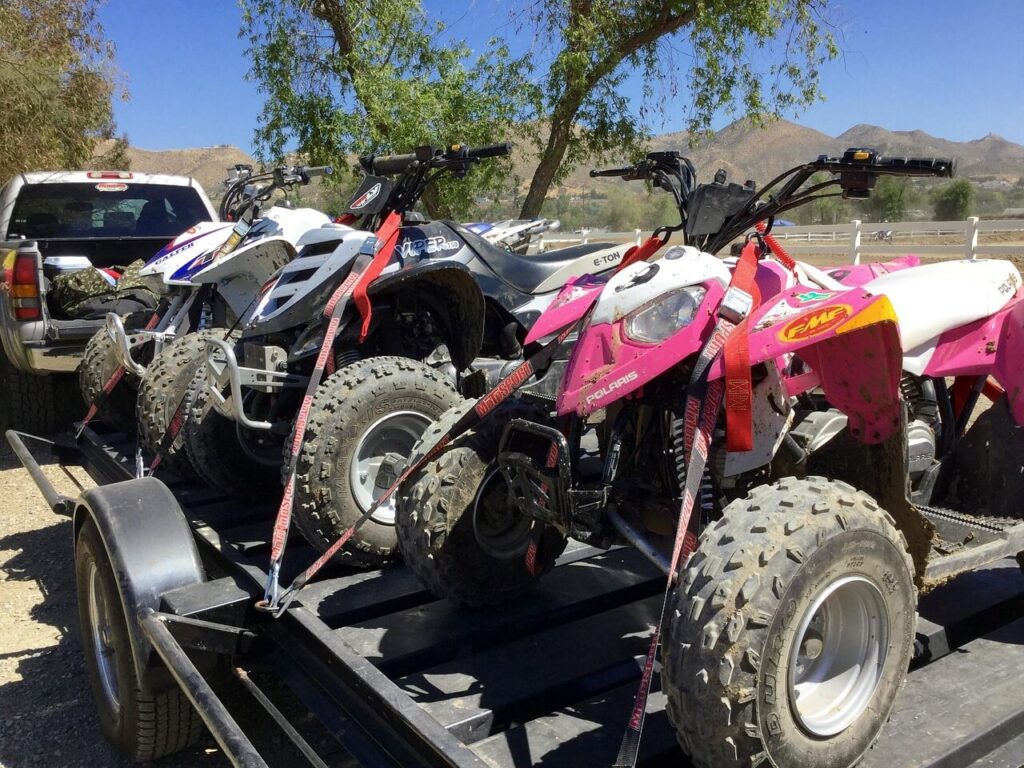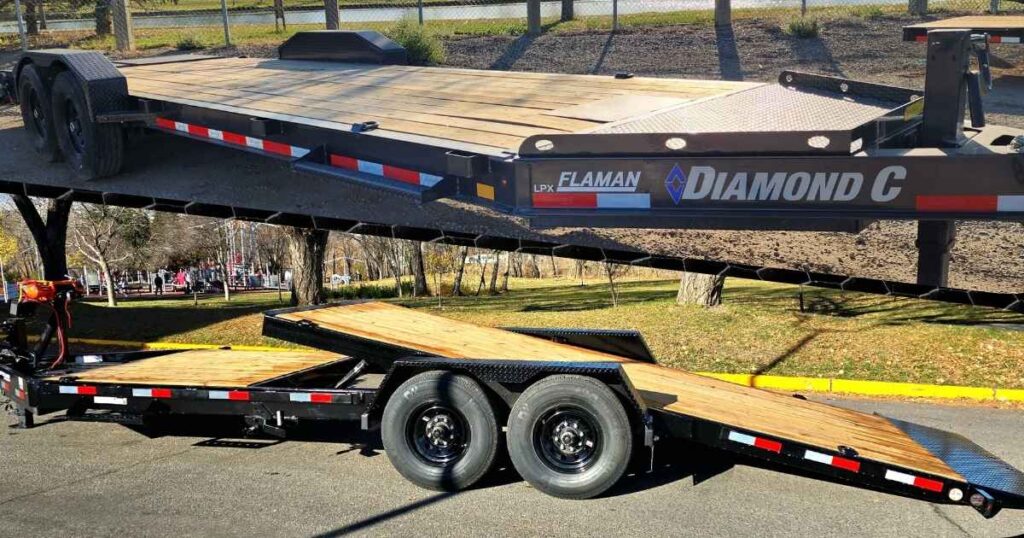





Towing safety depends on three linked systems: the trailer plug, the brake controller, and the hitch ball. A mismatch in any one can cause loss of control. This guide helps you choose between a 4-pin and 7-pin connector, determine when a brake controller is required, and match the correct hitch ball diameter and weight rating. Quick rule: no electric brakes means a 4-pin may suffice; electric brakes require a 7-pin and a brake controller.
Key Takeway
- Choose a 4 pin connector for trailers that need lighting only, while trailers with electric brakes require a 7 pin connector and a brake controller.
- Use a proportional brake controller for smoother braking and frequent heavy towing, or a time-delayed controller for occasional towing.
- Match the hitch ball diameter exactly to the trailer coupler and verify that the ball, mount, and receiver can support the load.
- Keep tongue weight around 10% to 15% of the loaded trailer weight to help maintain stability and safe handling.
- Check your vehicle’s towing capacity, hitch rating, wiring, lights, safety chains, and brake controller before towing.
- Verify the trailer brake requirements for your province or state, and never rely on an adapter to operate electric brakes without the correct wiring and controller.
The Three Decisions That Define a Safe Towing Setup
Each decision constrains the others. Start with the trailer’s braking needs.
- Trailer weight and braking: Determine whether you can use a 4-pin or must step up to a 7-pin, and whether a brake controller is legally and mechanically necessary.
- Brake controller type: Proportional or time-delayed. This determines how braking force is signaled through the 7-pin’s brake-output circuit.
- Hitch ball size and rating: Must exactly match the trailer coupler and support the loaded tongue weight.
Understanding Trailer Wiring: 4‑Pin vs. 7‑Pin Connectors
The trailer plug is the electrical link between the tow vehicle and the trailer. It runs the trailer’s lights and, on trailers with electric brakes, carries the signal that applies them. A plug that is wrong or not working leaves the trailer without brake lights or turn signals, which puts everyone behind you at risk.
What is a 4-Pin Trailer Plug?
A 4-pin trailer plug is a flat connector with four wires that carries lights only: a ground, running lights, and left and right turn and brake signals. It has no wire for electric brakes.
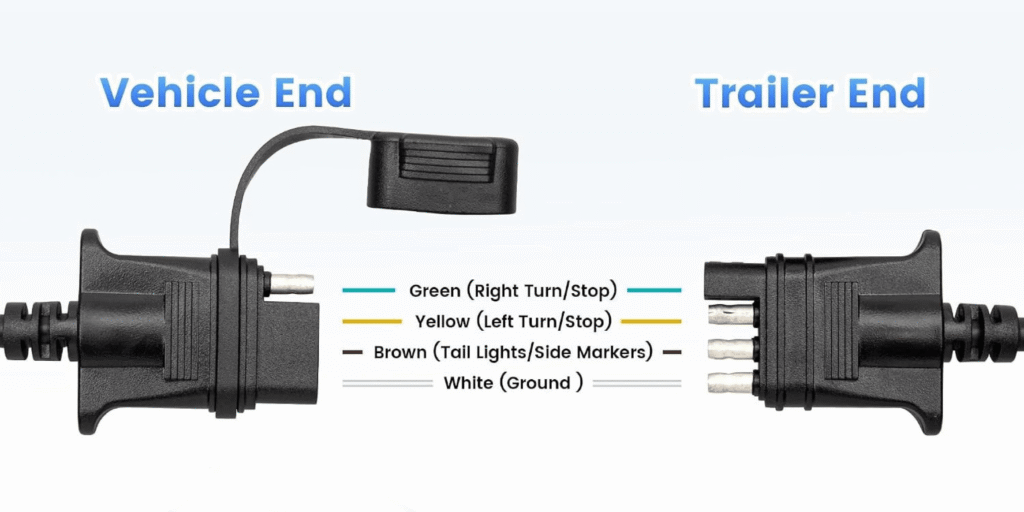
This is the standard connector for light-duty towing, such as small utility trailers, small cargo trailers and small boat trailers. These trailers are light enough that they usually do not have their own brakes, so the plug only needs to handle lighting.
The four functions are:
- Ground: completes the circuit so the trailer’s lights work
- Running lights: tail and side marker lights that make the trailer visible
- Left turn and brake: the left signal and left brake light on one wire
- Right turn and brake: the right signal and right brake light on one wire
What is a 7-Pin Trailer Plug?
A 7-pin trailer plug is a round connector with seven blade contacts. It carries everything a 4-pin plug does, plus an electric brake signal, 12V auxiliary power and reverse lights. In North America this is usually called a 7-way RV blade connector.
This is the connector for heavier towing, such as car haulers, travel trailers, dump trailers and larger enclosed trailers. Trailers in this range typically have electric brakes, and the 7-pin plug is the only common connector that can carry the brake signal.
What the 7-pin plug adds:
- Electric brake signal: sends the controller’s output to trailer brakes
- 12V auxiliary power: charges a trailer battery or powers accessories
- Reverse lights: lights up behind the trailer when you back up
4 Pin vs. 7 Pin Comparison Table
| Feature | 4 Pin Flat | 4 Pin Wire Color | 7 Pin (7 Way Blade) | 7 Pin Wire Color | What It Does |
|---|---|---|---|---|---|
|
Ground |
Yes |
White |
Yes |
White |
Completes the electrical circuit so the trailer lights work. |
|
Running lights |
Yes |
Brown |
Yes |
Green |
Powers the tail and side marker lights so others can see you at night. |
|
Left turn and brake |
Yes |
Yellow |
Yes |
Yellow |
The left signal and brake light share one wire. |
|
Right turn and brake |
Yes |
Green |
Yes |
Brown |
The right signal and brake light share one wire. |
|
Electric brake control |
No |
Not available |
Yes |
Blue |
Carries the brake controller’s output to the trailer. |
|
12V auxiliary power |
No |
Not available |
Yes |
Black or Red |
Charges a trailer battery or runs onboard accessories. |
|
Reverse lights |
No |
Not available |
Yes |
Purple, but may vary |
Powers the reverse lights when you back up. |
|
Typical trailers |
Utility, small cargo, small boat |
N/A |
Car hauler, dump, travel, larger enclosed |
N/A |
The connector type depends on the trailer’s electrical requirements. |
Note: Wire colors can vary by manufacturer and wiring standard. Always verify the connector pinout before connecting wires.
Can You Use an Adapter?
Only in one direction does an adapter give you everything.
- 7-pin vehicle, 4-pin trailer: Yes. you can use a 7-pin-to-4-pin adapter. The adapter powers the trailer’s lighting circuits only. This is acceptable because the trailer has no electric brakes.
- 4-pin vehicle, 7-pin trailer: No, not for braking. A 4-pin-to-7-pin adapter powers lighting only. The trailer’s electric brakes will not work because the vehicle has no brake controller and no brake output wire. You must upgrade the vehicle to 7-way wiring and install a brake controller. An adapter is acceptable only if you are towing a 7-pin trailer that has no electric brakes and needs lights only.
Quick Decision Rule
- If the trailer has electric brakes → you need a 7-pin and a brake controller.
- If the trailer is unbraked and lighting-only → a 4-pin may be sufficient.
Brake Controllers: Proportional vs. Time‑Delayed
A brake controller is a device installed in your truck that lets you brake the trailer along with the truck. When you press the tow vehicle’s brake pedal and sends an electrical signal to the trailer’s electric brakes through the 7-pin’s blue wire. Without a controller, the trailer’s electric brakes never engage and your tow vehicle has to stop the whole load alone.
Controllers come in two types, and they differ in how they decide how much braking power to send.
Time-Delayed
A time-delayed controller sends a preset amount of braking power to the trailer after a short delay whenever you press the brake pedal.
You choose the power level, called the gain, based on the trailer and its load. It does not react to how hard you are actually stopping, so the trailer brakes feel the same in a gentle stop as in a sudden one.
- Pros: lower cost, compact, and can be mounted in more positions
- Cons: less smooth braking and more wear on the brakes
- Best for: occasional towing and lighter loads
Proportional (Pendulum-Sensing)
A proportional controller senses how quickly the tow vehicle is slowing down and sends matching power to the trailer. Older designs use a pendulum that swings with deceleration, while newer ones use an accelerometer. The result is that the trailer brakes work in step with your truck: a gentle stop gets gentle trailer braking, and a hard stop gets more.
- Pros: smoother stops, less brake wear, better under heavy braking
- Cons: costs more, and many models must be mounted at a set angle
- Best for: frequent towing and heavy loads
When Are Brake Controllers Required?
If your trailer has electric brakes, you need a brake controller. Without one, the brakes will not work, and the 7-pin plug alone only carries the wiring. The rules on trailer brakes are set by each province and state, so there is no single answer.
Alberta Transportation law typically points to 910 kg (about 2,000 lb) of gross laden weight as the point where trailer brakes come into play, the point where trailer brakes come into play, while some US states set the figure as high as 4,500 lb. Gross laden weight means the trailer plus everything on it, so a trailer that is under the limit empty can be over it once loaded.

Get Your Tow Setup Ready Before Pickup
From enclosed trailers to car haulers and dump trailers, Westside Rental offers options for a range of hauling needs. Check your vehicle’s towing capacity, confirm your hitch and wiring, and find the right trailer for your load.
Understanding Your Vehicle’s Hitch Class and Capacity
Tongue Weight and Hitch Class
Tongue weight is how hard the loaded trailer presses down on the hitch ball, and it should be about 10% to 15% of the trailer’s loaded weight. Too little makes the trailer sway, and too much weighs down the back of your truck and hurts steering and braking. Your hitch class and receiver must be rated for both the trailer’s weight and its tongue weight.
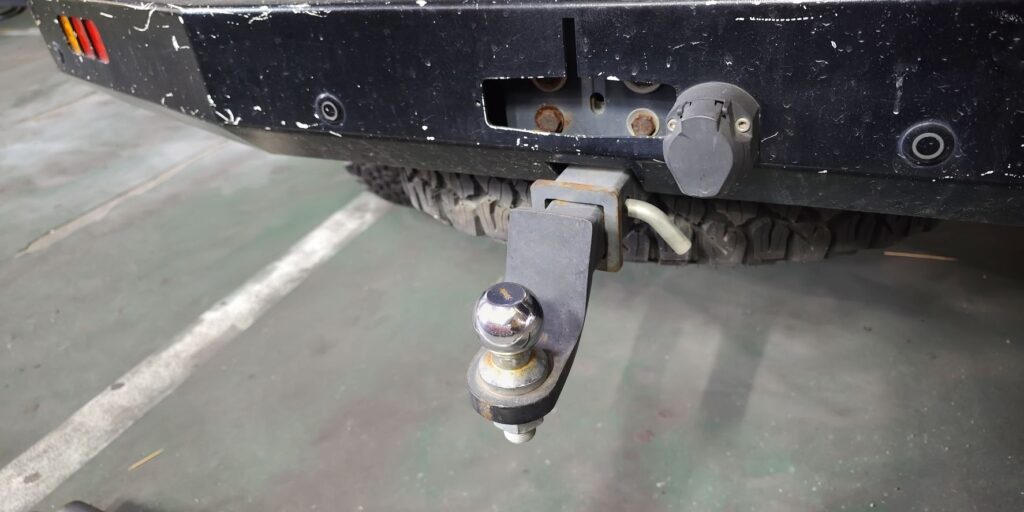
The 3 Standard Hitch Ball Sizes
Hitch balls come in three standard diameters. The capacities below are typical ranges only. The real rating depends on the individual ball, so always read the figure stamped on yours.
| Ball size | Typical capacity | Common use |
|---|---|---|
|
1-7/8 inch |
Under about 2,000 lb (900 kg) |
Small utility, light cargo and small boat trailers |
|
2 inch |
Up to about 8,000 lb (3,600 kg) |
Most utility, enclosed, car hauler and boat trailers |
|
2-5/16 inch |
Up to about 30,000 lb (13,600 kg) |
Equipment, larger enclosed, dump and RV trailers, gooseneck |
The 2 inch ball is the most common size and many pickups come with one already fitted. Heavier trailers often need the 2-5/16 inch size instead, which means swapping the ball before you tow.
For hitch class ratings and how to pick the right one, read the full trailer hitch guide.
Matching the Ball to the Coupler
The most important measurement is the coupler opening. Check the stamp on the coupler; if it is illegible, measure the inside diameter of the coupler’s ball socket. Then confirm that the ball diameter stamped on the ball matches that measurement exactly. Never “size up” or “size down” to make a ball fit—an undersized ball is a separation risk, and an oversized ball prevents the coupler latch from closing correctly.
Coupler and Ball Match Checklist
- Measure or read the coupler opening; confirm the required ball diameter.
- Confirm the ball diameter stamped on the ball matches the coupler exactly.
- Confirm the ball’s stamped weight rating ≥ loaded trailer GTW.
- Confirm the shank diameter and length fit the ball mount properly.
- Confirm the ball mount and receiver are rated for the load.
- Test the coupler latch engagement before towing; the latch must close fully and be pinned.
Pre-Towing Checklist: Is Your Vehicle Ready?
Run through this list at home before you head to pickup. It takes about five minutes.
| Component | Required check |
|---|---|
|
Towing capacity |
Your vehicle’s tow rating covers the trailer’s loaded weight |
|
Receiver tube size |
1-1/4 inch or 2 inch, and the ball mount fits the tube snugly |
|
Hitch rating |
The hitch class covers both the trailer weight and its tongue weight |
|
Hitch ball size |
Matches the size stamped on the trailer coupler exactly |
|
Ball shank and rating |
Shank fits the mount hole, and stamped capacity covers the load |
|
Plug type |
Matches the trailer’s 4-pin or 7-way plug, or you have the right adapter |
|
Lights |
Running lights, turn signals and brake lights tested with a helper |
|
Brake controller |
Installed and working if the trailer has electric brakes, with gain set |
|
Safety chains |
Two chains attached to the vehicle, with enough slack to turn |
If any row does not check out, fix it before pickup day. Most of these fixes are a ball, a ball mount, an adapter or a controller, and all are quick once you know what to get.
Final Thought
The plug, the controller, and the ball are not three separate purchases. They are three links in one safety chain. Start with the trailer’s actual braking needs. If it has electric brakes, commit to a 7-pin wiring setup and a brake controller. If it is lighting-only, a 4-pin may be sufficient, but the ball must still match the coupler exactly and the hitch must still support the load. Verify stamped ratings rather than guessing. Check state brake thresholds if you tow across borders. Run the pre-tow checklist before every trip.
When in doubt, have a qualified tow specialist inspect the 7-pin wiring and controller installation. The cost of a proper setup is always less than the cost of a separated trailer.
faq
Frequently Asked Questions
1. What is the difference between a 4-pin and a 7-pin trailer plug?
A 4-pin plug carries trailer lights only: ground, running lights, and left and right turn and brake signals. A 7-pin plug adds an electric brake signal, 12V auxiliary power and reverse lights. Use a 4-pin for light trailers without brakes and a 7-pin for trailers with electric brakes.
2. Can I tow a 7-pin trailer with a 4-pin vehicle?
You can plug it in with a 4-pin to 7-pin adapter, but only the lights will work. The adapter cannot supply a brake signal, so electric trailer brakes will not engage. If the trailer has electric brakes, add 7-way wiring and a brake controller to the vehicle before you tow.
3. Do I need a brake controller for a trailer with electric brakes?
Yes. Electric trailer brakes only work when a brake controller in the tow vehicle sends them power. Without one, the trailer brakes stay off and your vehicle has to stop the whole load alone. The 7-pin plug only carries the signal, so it cannot replace the controller.
4. What size hitch ball do I need for my trailer?
Use the size stamped on the trailer’s coupler, which will be 1-7/8 inch, 2 inch or 2-5/16 inch. The ball must match exactly. Also check that the stamped weight rating on the ball is at least the trailer’s loaded weight, and that the shank fits your ball mount hole.
5. Can I use a 2-inch ball on a 2-5/16 inch coupler?
No. A 2-inch ball is too small for a 2-5/16 inch coupler. It sits loose, the trailer can bounce and sway, and the coupler can slip off the ball under load. Swap to a 2-5/16 inch ball to match the coupler. A 2-5/16 inch ball will not fit into a 2-inch coupler at all.
6. What is the difference between proportional and time-delayed brake controllers?
A time-delayed controller sends a preset amount of braking power after a short delay, so every stop feels the same. A proportional controller senses how hard the tow vehicle is slowing and sends matching power, giving smoother stops and less brake wear. Proportional suits frequent or heavy towing.